EFFECTS OF ELECTRIC CURRENT EXERCISE
1.Tell the odd one out. Give proper explanation.
2.Fuse wire, bad conductor, rubber gloves, generator
Ans. – Generator.
Others restrict flow of current while generator is used to produce current.
3.Loud speaker, microphone, electric motor, magnet
Ans. – Magnet.
Others are devices which convert energy from one form to another while magnet is not used as a device for energy conversion.
4.Voltmeter, ammeter, galvanometer, thermometer
Ans. – Thermometer.
Others work on magnetic effect of electric current while thermometer does not work on magnetic effect of electric current.
2.Explain the construction and working of the following. Draw a neat diagram and label it. a. Electric Generator (AC) Electric motor
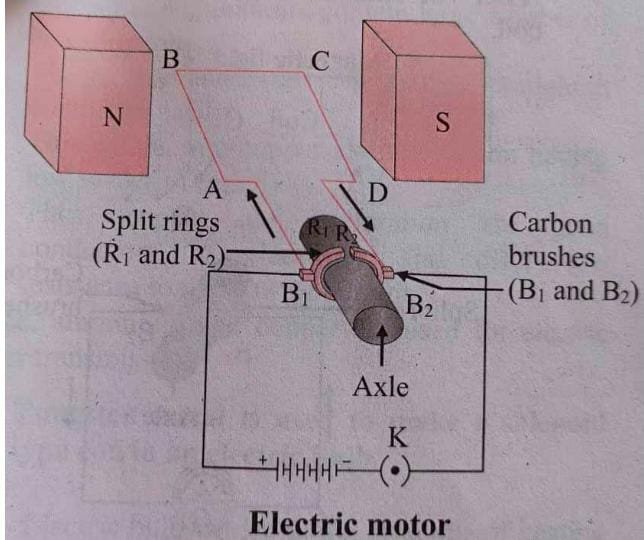
1.Electric motor:
It is a device which converts electrical energy into mechanical energy.
Construction: Electric motor consists of following parts:
Rectangular coil: A large number of turns of insulated copper wire wound on iron core in rectangular shape forms a coil ABCD as shown in figure.
Strong magnet: The coil is placed in between two pole pieces (N and S) of a strong horse shoe magnet which provides a strong magnetic field. The sides AB and CD are perpendicular to the direction of magnetic field.
Split ring: It consists of two halves of a metallic ring (R1 and R2). The ends of the coil are connected to these rings.
The outer conducting surfaces of spilt rings R1 and R2 are in contact with the two stationary carbon brushes. Spilt rings reverse the direction of current in the coil.
Brushes: Two carbon brushes B1 and B2 are used to press the split rings.
Axle: The two halves of the rings have resistive coating in their inner surface and are tightly fitted on the axle. The main function of axle is to rotate with the coil.
Battery: The battery supplies the current to the coil
EFFECTS OF ELECTRIC CURRENT EXERCISE
Working:
When the circuit is completed, the current passes through the brush B₁ from A to B in branch AB.
As, the magnetic field acts from north pole to south pole, according to Fleming’s left hand rule, the force experienced by arm AB is in the downward direction and arm CD is in the upward direction.
Both these forces are equal in magnitude and opposite in direction and hence, the coil rotates in anticlockwise direction.
After half rotation, the split rings R2 and R1 come in contact with brushes B1 and B2 respectively.
Again the current starts passing through the coil in opposite direction.
The force acting on branch BA is upward and DC is downward, this force again moves the coil in anticlockwise direction.
This shows that the current in the loop ABCD is reversed after every half rotation, and the loop continues to rotate in same direction.
Thus, the coil rotates with the help of electrical energy.
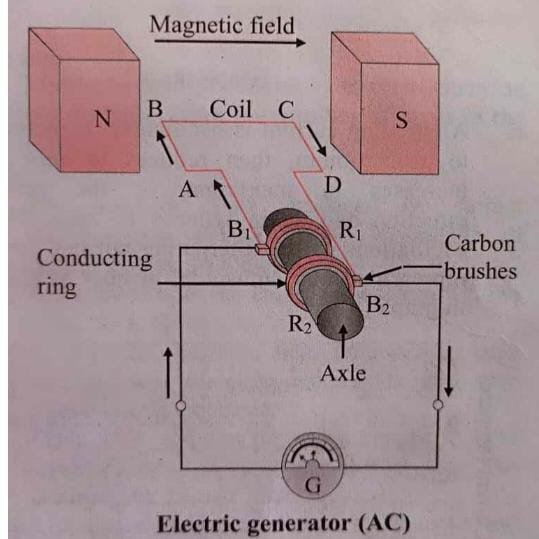
2.Electric Generator (AC)
A generator which converts mechanical energy into electrical energy in the form of alternating current is called A.C. generator.
Construction: The main components of A.C. generator are:
Rectangular coil: A large number of turns of insulated copper wire wound on iron core in rectangular shape forms a coil ABCD as shown in figure.
Strong magnets: The coil is placed in between two pole pieces (N and S) of a strong magnet. This provides a strong magnetic field.
Rings: The two ends of the coil are connected to two rings R1 and R2. These rings rotate along with the coil.
Brushes: Two carbon brushes B1 and B2 are used to press the rings.
Axle: The two rings have resistive coating in their inner surfaces and are tightly fitted on the axle and the function of the axle is to rotate with the coil.
EFFECTS OF ELECTRIC CURRENT EXERCISE
Working:
When the axle is rotated with the help of a machine from outside, the coil ABCD starts rotating.
On rotating the axle, the branch AB move upwards and branch CD move downwards hence coil ABCD rotates clockwise.
According to Fleming’s right hand rule, electric current flows in the direction
A→B-C→D. Therefore, current flows from B2 to B, in the external circuit through galvanometer.
After half rotation, the branch AB and CD exchange their position and the induced current flows as D→C→B→A.
Since, branch BA is in contact with brush B, and branch DC is in contact with B2, current flow from B₁ to B2 in the external circuit i.e., in the opposite to the previous half rotation.
This repeats after every half rotation and in this way, alternate current is produced using AC generator.
3.Electromagnetic Induction Means-
(A) Charging of an electric conductor.
(B) Production of magnetic field due to a current flowing through a coil.
(C) Generation of a current in a coil due to relative motion between the coil and the magnet.
(D) Motion of the coil around the axle in an electric motor.
4.Explain the difference
EFFECTS OF ELECTRIC CURRENT EXERCISE
AC Generator and DC generator
| AC Generator | AC Generator | |
| 1 | It is used to produce alternating current. | It is used produce direct current. |
| 2 | In the A.C. generator, the flow of current in the circuit reverses the direction after every half rotation of the coil.
|
In the D.C. generator, the direction of current is same as long as the coil rotates in the magnetic field.
|
| 3 | Rings used in an A.C. generator are not split.
|
Split rings are used in a D.C. generator.
|
EFFECTS OF ELECTRIC CURRENT EXERCISE
5.Which device is used to produce electricity? Describe with a neat diagram.
(A) Electric motor
(B) Galvanometer
(C) Electric Generator (DC)
(D) Voltmeter
Ans: (C) Electric Generator (DC)
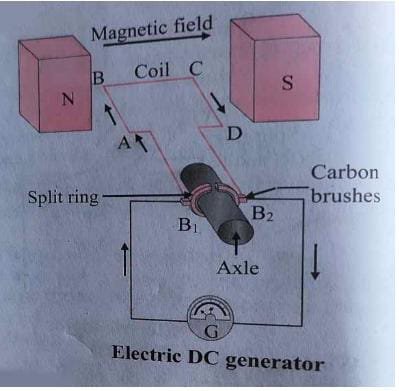
A generator which converts mechanical energy into electrical energy in the form of direct current is called as D.C. generator.
Construction: The main components of D.C. generator are:
Rectangular coil (ABCD): It consists of a large number of turns of insulated copper wire wound on an iron core in rectangular shape.
Strong magnets: The coil is placed between the two pole pieces (N and S) of a strong magnet that produces a strong magnetic field.
Split ring: It consists of two halves of a metallic ring to which the ends of the coil are connected.
Brushes: Carbon brushes (B1 and B2) are used to press the rings.
Axle: The function of axle is to rotate with the
EFFECTS OF ELECTRIC CURRENT EXERCISE
Working:
When the axle is rotated with the help of a machine from outside, the coil ABCD starts rotating.
On rotating the axle, the branch AB move upwards and branch CD move downwards and coil ABCD rotates clockwise.
According to Fleming’s right hand rule, electric current flows in the direction A→B→C→D. Therefore, current flows in the external circuit through galvanometer.
After half rotation, the branch AB and CD be exchange their position and the induced current flows as D→C→B→A.
Since, the branch which is moving upwards is always in contact with brush B1, and the branch which is moving downwards is always in contact with brush B2, current flows in the same direction in the external circuit, thereby producing different current.
6.How does the short circuit form? What is its effect?
The household electrical connections mainly consist of live, neutral and earth wires.
The potential difference between live and neutral wires is around 220 V.
Sometimes, due to fault in the electrical appliances or damage of the insulating coating around the neutral and live wires, the two wires come in contact with each other and large current flows through them causing short circuit.
Large amount of heat is produced due to flow of this large current.
Any inflammable material like wood, plastic, cloth, etc. present around the short circuited place can catch fire.
If fuse wire connected, then the short circuit results in melting of fuse wire and the possible damage to house can be avoided.
EFFECTS OF ELECTRIC CURRENT EXERCISE
7.Give scientific reasons.
a. Tungsten metal is used to make a solenoid type coil in an electric bulb
Electric bulb works on the principle of heating effect electric of current.
The solenoid type coil of bulb has high resistivity and very high melting point.
When current is passed through the bulb, solenoid type coil of bulb gets heated to high temperature (up to 3400 °C) and starts glowing.
Hence, tungsten metal is used to make a solenoid type coil in an electric bulb.
b.In the electric equipment producing heat e.g. iron, electric heater, boiler, toaster etc. an alloy such as nichrome is used, not pure metals.
The heating devices such as iron, electric heater, toaster, boiler etc. works on the principle of heating effect of electric current.
Alloys (such as nichrome) as compared to metals have higher resistivity.
Unlike metals they can be heated to higher temperature.
Hence, heating devices are made of alloys rather than a pure metal
c .For electric power transmission, copper or aluminium wire is used.
Copper and aluminium contain large number of free electrons.
These free electrons can move throughout conductor easily.
This results into lowering the resistivity.
Thus, copper and aluminium are good conductors of electricity and offer low resistance to the flow of current.
Hence, aluminium and copper are used for electric power transmission.
In practice the unit kWh is used for the measurement of electrical energy, rather than joule.
Electrical energy = Electrical power x time.
For practical applications, devices consuming high electrical power are used over the period of time.
This leads to heavy expenditure of electrical energy.
To measure such value of energy unit joule is significantly small.
Hence, unit kWh is used in practice.
Unit 1 kWh represents power of 1 kW used for 1 hour and equals 3.6 x 10⁶ j
8.Which of the statement given below correctly describes the magnetic field near a long, straight current carrying conductor?
The magnetic lines of force are in a plane, perpendicular to the conductor in the form of straight lines.
The magnetic lines of force are parallel to the conductor on all the sides of conductor.
The magnetic lines of force are perpendicular to the conductor going radially outward.
The magnetic lines of force are in concentric circles with the wire as the centre, in a plane perpendicular to the conductor.
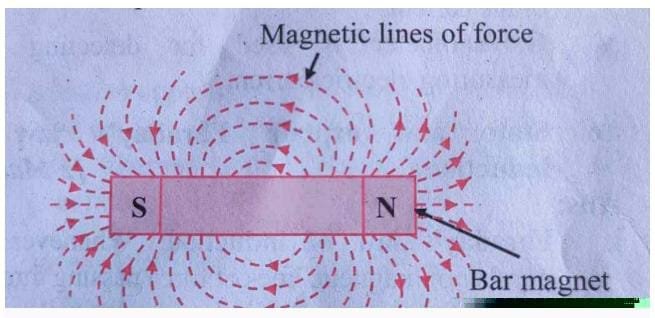
9.What is a solenoid? Compare the magnetic field produced by a solenoid with the magnetic field of a bar magnet. Draw neat figures and name various components.
When a copper wire with a resistive coating is wound in a chain of loops (like a spring), it is called as solenoid.
Whenever electric current passes through a solenoid, magnetic lines of force are produced in a pattern as shown in the figure.
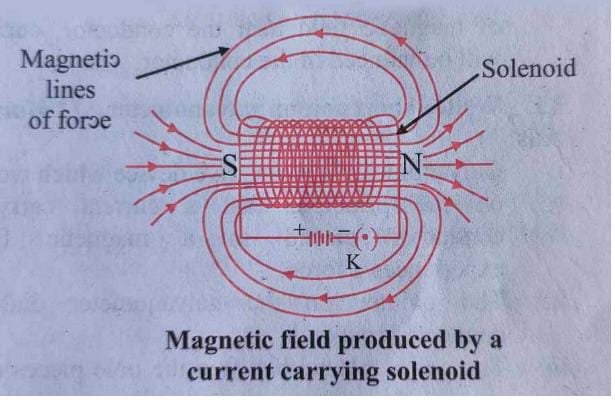
The magnetic field produced by a solenoid is similar to the magnetic field of a bar magnet.
One end of the coil acts as South Pole and the other end acts as North Pole whereas, the field lines are parallel inside the solenoid.
EFFECTS OF ELECTRIC CURRENT EXERCISE
10.Name the following diagrams and explain the concept behind them.
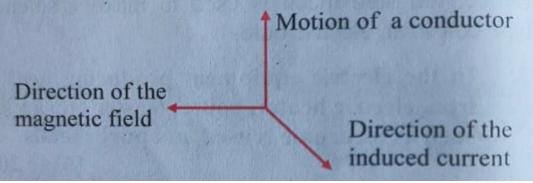
Fleming’s right hand rule:
Stretch the thumb, index finger and middle finger of the right hand so that they are perpendicular to each other. If the index finger indicates the direction of magnetic field and the thumb shows the direction of motion of the conductor, then the middle finger will show the direction of induced current.
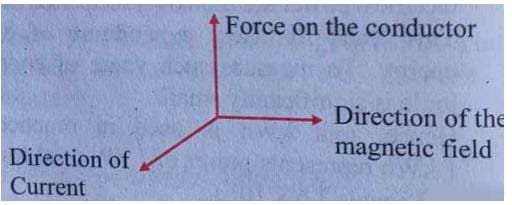
Fleming’s left hand rule:
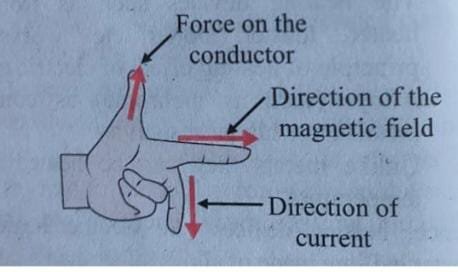
Stretch the index finger, the middle finger and the thumb of the left hand mutually perpendicular to each other. If the index finger is in the direction of the magnetic field and the middle finger points in the direction of the current, then the thumb will point towards the direction of the force on the conductor.
11.Identify the figures and explain their use.

EFFECTS OF ELECTRIC CURRENT EXERCISE
Fuse:
Fuse is used in electric circuit to protect the electrical appliances from damaging due to short circuit or overloading.
Miniature circuit breakers (MCB) switches:
MCB switches are used in households. When the current in the circuit suddenly increases, this switch opens and stops the current.
DC generator: DC generator is used to convert mechanical energy into electrical energy in the form of direct current.
12.Solve the following example.
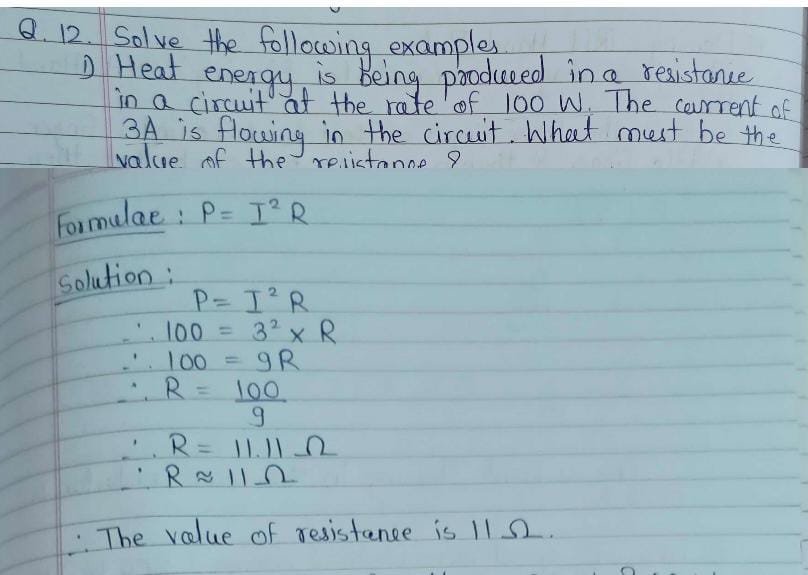
a. Heat energy is being produced in a resistance in a circuit at the rate of
100 W. The current of 3 A is flowing in the circuit What must be the value of the resistance?
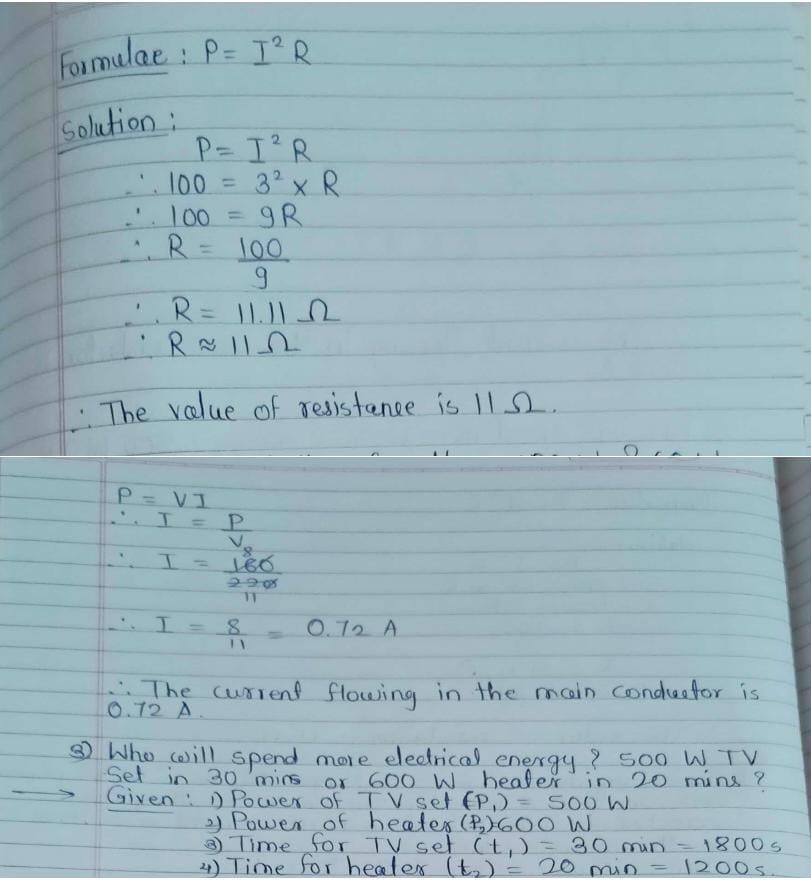
Two tungsten bulbs of wattage 100 W and 60 W power work on 220 V potential difference. If they are connected in parallel, how much current will flow in the main conductor?
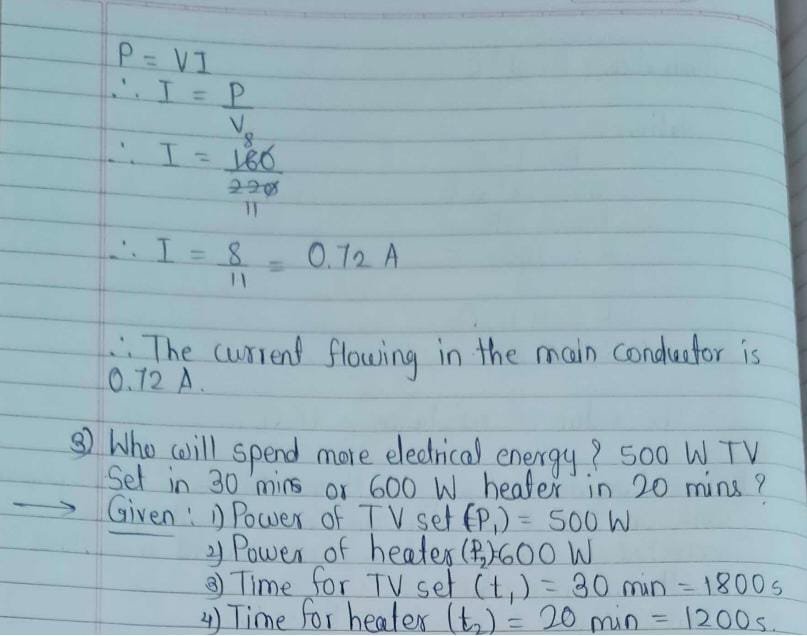
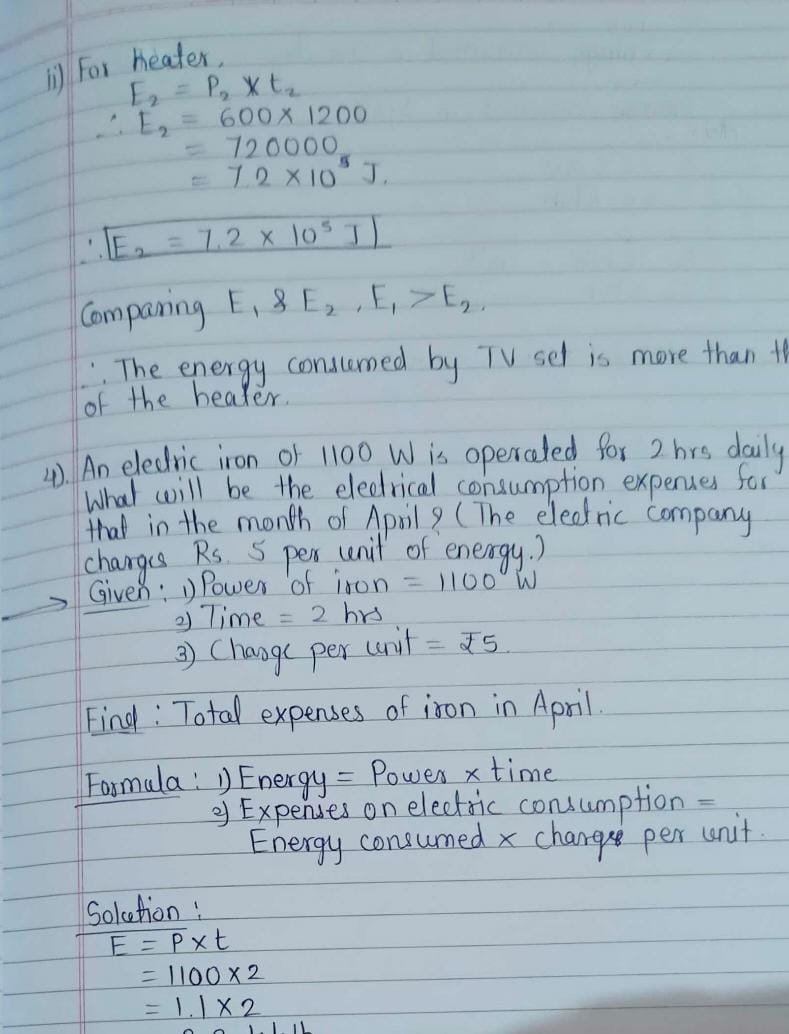
Who will spend more electrical energy? 500 W TV Set in 30 mins, or 600 W heater in 20 mins?
EFFECTS OF ELECTRIC CURRENT EXERCISE
EFFECTS OF ELECTRIC CURRENT EXERCISE
https://akshatakirpekar.com/gravitation-pyq/
https://youtu.be/zV0gwjYePlI?si=2jIp9Gnfv2nJ2PRD
EFFECTS OF ELECTRIC CURRENT EXERCISE