ANIMAL CLASSIFICATION
Can you recall (Page 61) –
Which criteria are used for classification of organisms?
a. Complexity of cell structure –
Prokaryotic or eukaryotic
b. Complexity of body organization –
Unicellular, multicellular
c. Presence / absence of cell wall –
Cell wall present: Plants; cell wall absent: Animals
d. Mode of nutrition –
Autotrophic, heterotrophic, saprophytic
e. Mode of reproduction –
Asexual, sexual
Can you recall (Page 61) –
How the plants are classified?
Presence or absence of organs:
Thallophyta and Bryophyta (thalloid plant body, without root, stem and leaves).
Pteridophyta, Phanerogams (with root, stem and leaves).
Presence or absence of separate conducting tissues for
Conduction of water and food:
Bryophyta and thallophyta (without specialised conducting tissue).
Pteridophyta and phanerogams (with specialised tissues for conduction of water and food).
Presence or absence of flowers, fruits and seeds:
Phanerogams (Have seeds) Cryptogams (Lack flowers, fruits and seeds)
Whether seeds are enclosed within a fruit or not:
Gymnosperms (seeds are not enclosed within fruit).
Angiosperms (seeds are enclosed with fruit). number of
cotyledons in the seed;
Monocotyledons (have seeds with one cotyledon).
Dicotylendons (have seed with two cotyledons)
There are around 7 million animal species on the earth.
The animals are classified by forming groups and subgroups depending upon similarities and differences.
Classification can be defined as system of arrangement of organisms into different groups and subgroups on the basis of their similarities, differences and relationship.
History of classification –
Different scientists have tried to classify animals from time to time.
Early classification attempts were done by Aristotle, Theophrastus.
Artificial System of Classification –
Greek philosopher Aristotle was the first to classify animals on the basis of criteria like body size, habits and habitats.
This method of classification proposed by Aristotle is called – Artificial method.
This method was followed by Theophrastus, Pliny, John Ray, Linnaeus, etc.
Drawback –
It did not reflect natural relationship of organisms (All flying animals insects, birds etc. were placed together, Animals living in water were placed together.)
Natural System of Classification –
Living organisms are categorized into broad groups on basis of large number of characters
Criteria used for classification –
Body organization, types of cells, Chromosomes, biochemical properties, etc.
– After this, system of classification based on evolution was brought into practice which was proposed by Dobzhansky and Mayr.
– Carl Woese proposed the six kingdom classification system.
– In this system, he divided animals into 6 kingdoms – Eubacteria, Archaebacteria, Protista, Fungi, Plantae, and Animalia.
– Presently, five kingdom system proposed by R.H.Whittaker is in use. According to this system, animals are classified based on criteria like body organization, body symmetry, body cavity, germinal layers, segmentation.
Benefits / Advantages of animal classification –
– Animal study becomes convenient.
– One can identify animals with great accuracy.
– One can understand the relationship of animals with other living organisms.
– Helps to understand habitat and role of each animal.
– By studying few animals from a group, we can understand about the entire group.
– One can understand adaptations made by animals.
– Gives idea about evolution.
Traditional method of animal classification
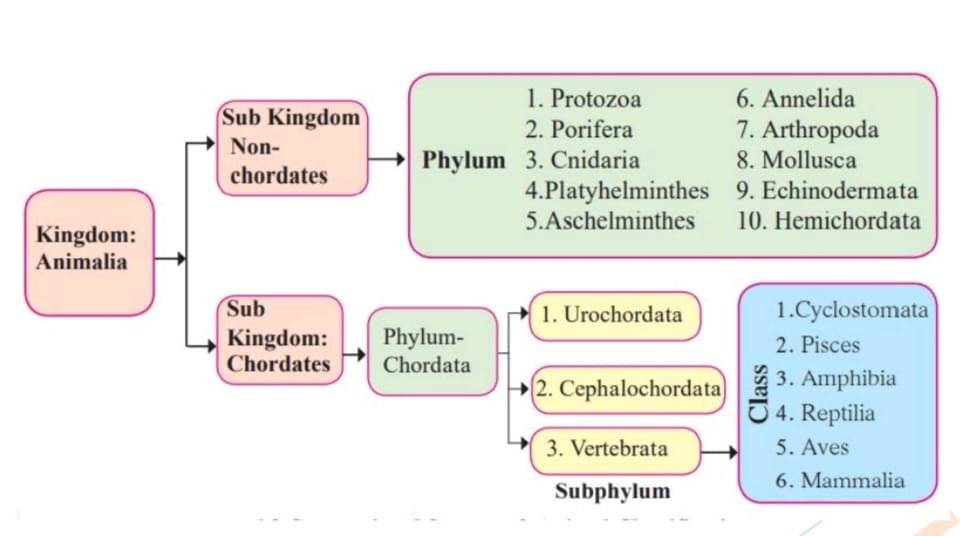
Traditionally, depending upon presence or absence of the notochord, the animal
Kingdom has been divided into two groups- Non-chordates and Chordates
(Notochord is a stiff, rod like structure that develops into vertebral column.)
A. Non-Chordates:
– Body not supported by rod-like notochord.
– Pharyngeal gill-slits are absent.
– Nerve cord if present, it is on ventral side. It is solid & paired.
– Heart, if present, it is on dorsal side
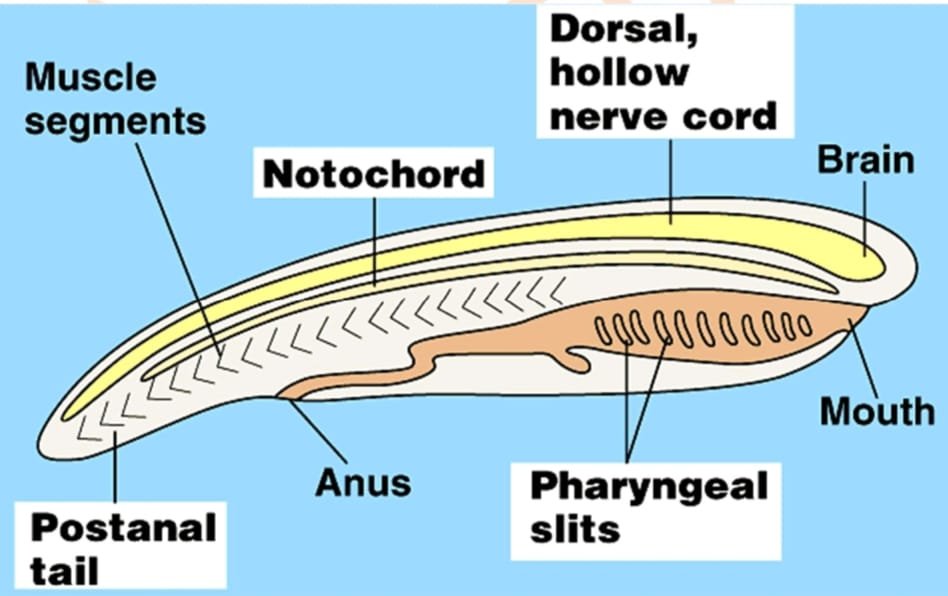
B. Chordates:
– Body is supported by notochord.
– Pharyngeal gill-slits or lungs for respiration.
– Nerve cord on dorsal side of body and hollow.
– Heart on ventral side of body.
animal classification
Criteria for new system of classification
Grades of organization
1. Protoplasmic grade – Ex. unicellular organisms like amoeba, paramoecium.
Body is composed of a single cell which performs all functions.
2. Cellular grade – Ex. Porifera
Body consists of only cells, no tissues are formed.
3. Cell – tissue grade – Ex. Animals from phylum- Cnidaria The cells come together to form tissues
4. Tissue Organ grade – Ex Flatworms ( Platyhelminthes) Tissues are organized to form organs. Complete organs are not formed.
5. Organ – system grade – Ex. Aschelminthes onwards Different organs come together to form systems that perform specific functions.
Germ layers –
These are formed during initial period of embryonic development from which, different tissues are formed in the body.
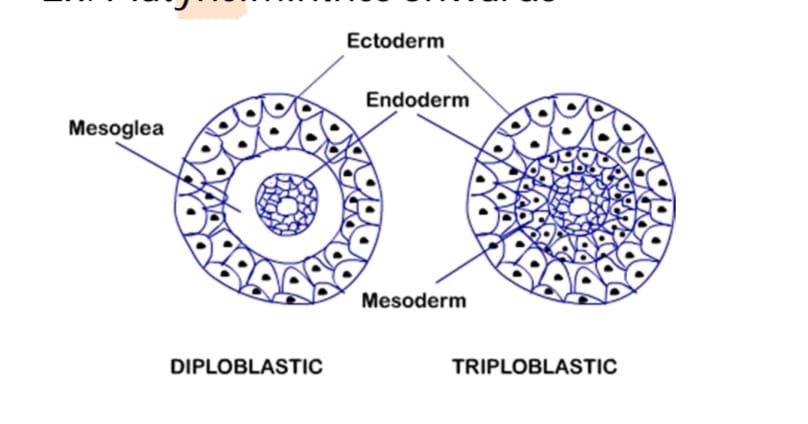
Animals can be diploblastic or triploblastic depending on presence or absence of germ layers.
Diploblastic – Animals with 2 germ layers.
Outer ectoderm that develops into skin; inner endoderm Ex. Cnidarians
Triploblastic –Animals with 3 germ layers.
Outer ectoderm that develops into skin; middle mesoderm that develops into muscles; inner endoderm that develops into organs and other tissues
Ex. Platyhelminthes onwards
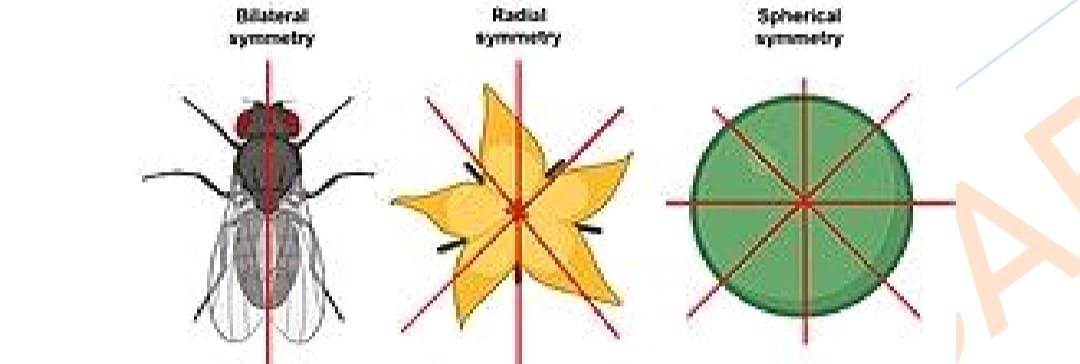
Body Symmetry –
1. Asymmetry –Ex. Sponges
Body can’t be divided into 2 equal parts at any plane
2. Radial – Ex. Starfish
Imaginary cut passes through central axis and divides body into equal parts.
3. Bilateral –Ex. Human, insects, etc.
Body divided into 2 equal parts in only 1 imaginary axis
Body cavity / Coelom –
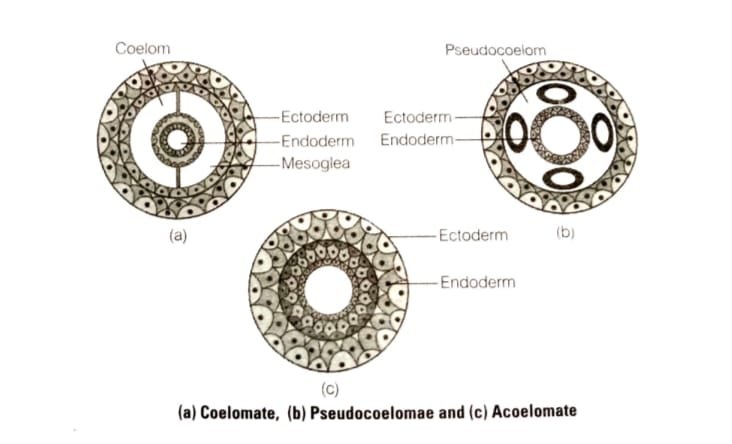
The coelom is the fluid-filled body cavity present between the alimentary canal and the body wall.”
During initial developmental stages, it is formed from mesoderm.
Depending upon presence or absence of body cavity, animals can be –A. Eucoelomates / coelomates –
Animals with true body cavity.
Ex. Animals in phylum Annelida onwards
B. Pseudocoelomates – Animals with false body cavity. Instead of body cavity, patches of mesodermal cells are present
Ex. Aschelminthes
C. Acoelomates – Animals with no body cavity.
Ex. Porifera, Cnidaria, Platyhelminthes
animal classification
Segmentation –
The body of animals is divided into small, similar units. Each small unit is called segment.
Ex. Earthworm.
PHYLUM NON CHORDATA
A. Porifera –
Ex. Sycon, Euspongia (bath sponge), Hyalonema, Euplectella, etc.
– Cellular grade organization.
– Multicellular, asymmetric body
– Acoelomates
– Simplest body plan
– Usually called as sponges.
– Mostly marine, few are fresh water dwellers.
– Body bears numerous pores. Smaller and many pores – Ostia. Single and large pore – Osculum.
– Water enters through Ostia and comes out through Osculum
– Collar cells for digestion.
– Sedentary
– Spicules or sponging fibres for support. Spicules are made of calcium carbonate or silica.
– Sexual reproduction (egg and sperms); asexual reproduction by budding.
– High power of regeneration.
animal classification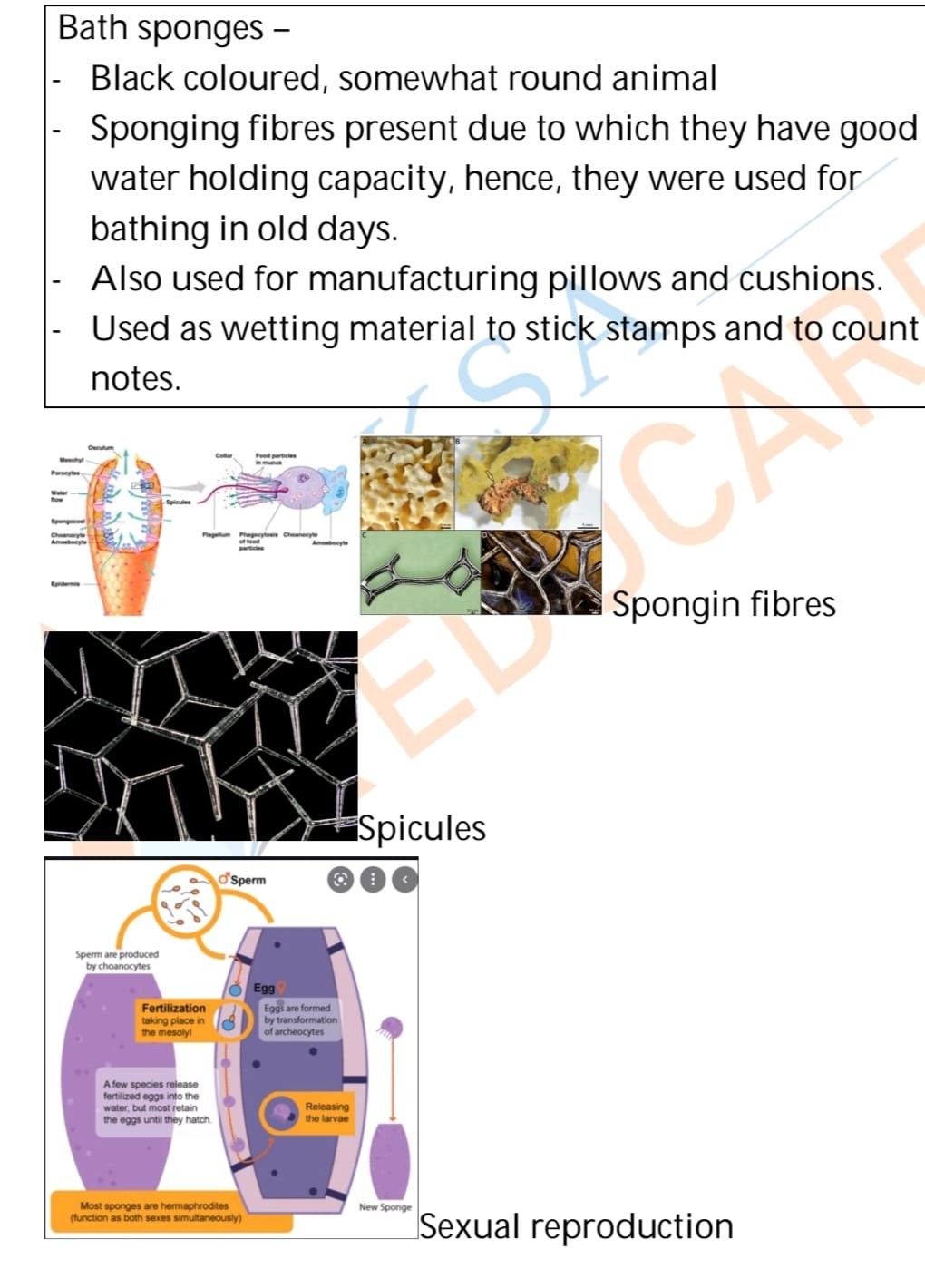
B. Cnidaria / Coelenterata –
– Ex. Hydra, Adamsia (Sea anemone), Physalia (Portuguese- man-of war), Aurelia (Jelly fish) Corals, Etc.
– Cell tissue grade organization
– Radial symmetry
– Acoelomates
– Diploblastic
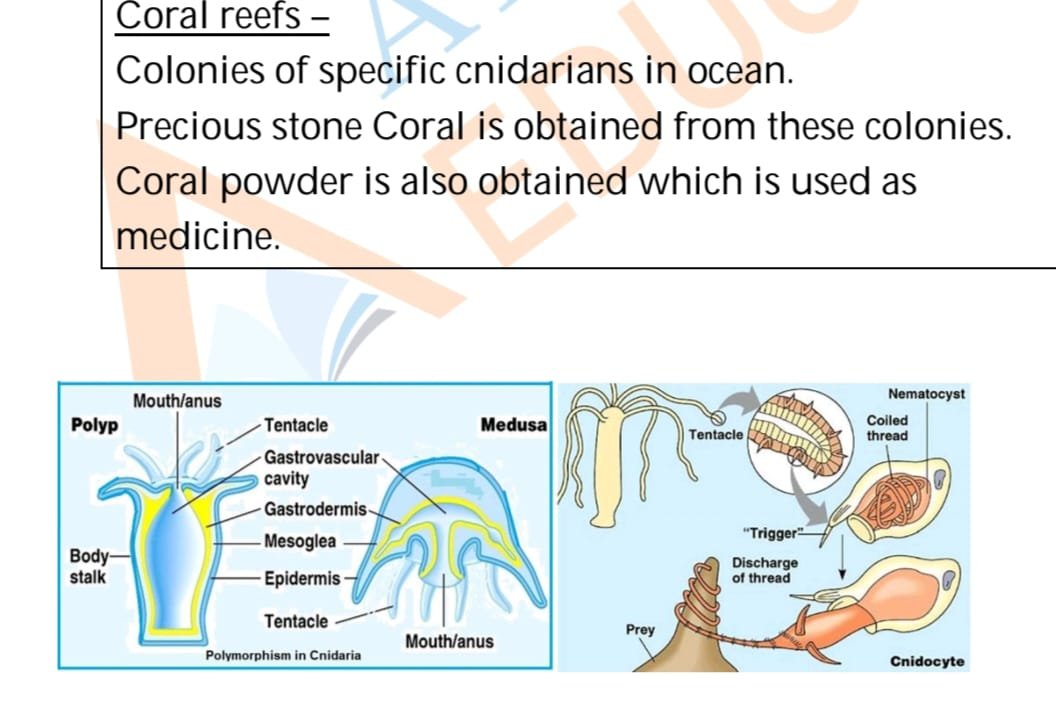
– Body is cylindrical or umbrella like. Cylindrical body – Polyp; Umbrella shaped body – Medusae.
– Mostly marine; few are fresh water forms
– Sensory tentacles are present around mouth. They bear cnidoblasts. The cnidoblasts are useful for injecting toxins in the body of prey. Also they are useful in protection from predators.
animal classification
C. Platyhelminthes –
Ex. Planaria, Liver fluke, Tape worm, etc.
– Include flat worms
– Tissue organ grade organization
– Bilateral symmetry
– Triploblastic
– Acoelomates
– Body is flat, slender, leaf like or ribbon like
– Endoparasites, few are free living and aquatic
– Hermaphrodite (male and female reproductive systems are present in same body)
– Sexual dimorphism is seen
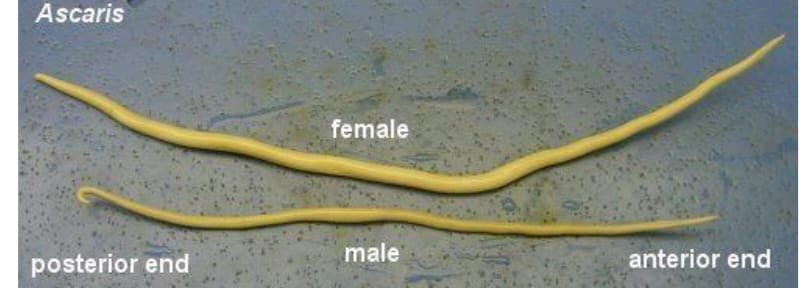
D. Aschelminthes –
Ex. Ascaris (Intestinal worm), Filarial worm, Loa loa (Eye worm), etc.
– Organ system grade organization
– Bilateral symmetry
– Triploblastic
– Pseudo coelomates
– Include round worms.
– Long, cylindrical body
– Body covered with tough cuticle
– Free living or Endoparasites
– unisexual
animal classification
Collect the Information (Page 69) –
How does the infection of tapeworm in man, liver fluke in grazing animals like goat and sheep occur and what are their preventive measures?
Infection of tapeworm –
Grazing animals get infected while grazing or drinking contaminated water.
If humans consume raw meat of these animals, they get infected.
Humans can also get infected if they consume water contaminated with faces of infected person.
Preventive measures –
Maintain personal hygiene, washing fruits and vegetables, properly cooking meat.
Infection of liver fluke –
Liver flukes are found in water bodies where they lay eggs. The eggs develop into larvae. The larvae then move to grassy vegetation. When such grass is eaten by grazing animals, it enters into their intestine and then liver. It then matures into an adult.
Preventive measures –
Draining wet areas of pasture, gracing in drier pasture, avoiding snail infected area for grazing.
How does the infection of round worms like Ascaris, filarial worm & plant nematodes occur and what are their preventive measures and treatment?
Infection of Ascaris
Ascaris is an intestinal endoparasite in humans that causes ascariasis.
Female lays the eggs, which are released from the human body through the faeces and can infect other humans.
Humans also become infected through ingestion of eggs through contaminated food (e.g. vegetables and fruits) and water.
Preventive measures:
Proper disposal of human faeces, maintaining personal hygiene, covering food, etc.
Treatment:
Using anthelmintic drugs.
Infection of Filarial worm:
It causes filariasis.
It is caused by Wuchereria bancrofti which is found in lymph vessels and lymph nodes of man (primary host).
They need a secondary host like Aedes and Culex mosquitoes to complete their life cycle.
When infected mosquitoes bite humans, it get injected in the blood of humans.
Preventive measures:
Avoiding exposure to mosquitoes by using insecticides, insect repellents, nets on doors and windows to check the entry of mosquitoes.
Treatment:
Using anthelmintic drugs
Infection of plant nematodes:
Nematodes attack the roots, stem, foliage and flowers of plants.
The roots infected with nematodes shows root galls, injured root tips and stunted root system.
Preventive measures:
E. Annelida –
Ex. Earthworm, Leech, Nereis, etc.
– Organ system grade organization
– Bilateral symmetry
– Triploblastic
– True coelomates
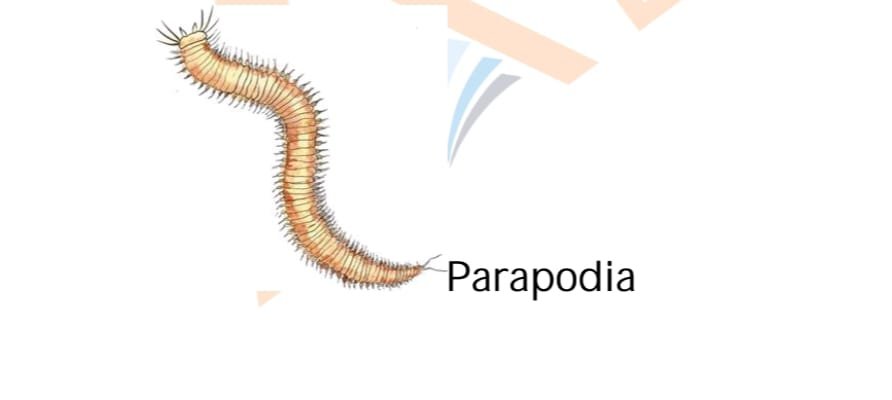
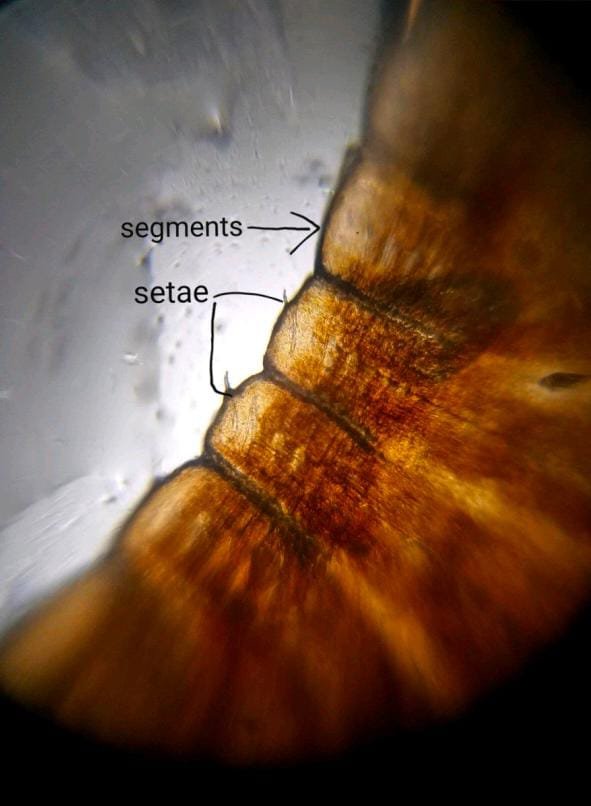
– Long, cylindrical, metamerically segmented body.
– Mostly free living, few are ectoparasites.
– Setae, suckers or parapodia for locomotion.
– Body covered with cuticle
– Either hermaphrodite or unisexual
animal classification
Get information (Page 69) –
Why earthworm is called as friend of farmers?
They loosen the soil by burrowing deep into it. This help to aerate the soil also helps the water to reach the roots quickly. Earthworms can decompose the organic matter from soil and convert it into manure. This helps in increasing the fertility of soil. Hence, earthworm is called as friend of farmers.
How may be the leech used in ayurvedic system of treatment?
Leeches are used in blood purification therapy to treat many diseases.
They suck impure blood from the affected site of the patient’s body. An anticoagulant Hirudin is present in the saliva of leech. It makes blood thinner and dissolve the clots in blood vessels.
F. Arthropoda –
– Ex. Crab, spider, scorpion, millipede, centipede, cockroach, butterfly, honeybee, etc.
– Organ system grade organization
– Bilateral symmetry
– Triploblastic
– True coelomates
– Segmented body.
– Animals have jointed appendages
– Earth has highest number of animals from this phylum.
– Phylum with highly successful animals.
– Animals are found in all types of habitats.
– Chitinous exoskeleton is present around body
– Unisexual animals.
animal classification
G. Mollusca –
– Ex. Bivalve, Snail, Octopus, etc.
– Organ system grade organization
– Bilateral symmetry
– Triploblastic
– True coelomates
– Non segmented body
– Soft and slimy body
– Aquatic or terrestrial
– Body divided into head, foot and visceral mass
– Visceral mass covered with a mantle secreting hard calcareous shell
– The shell may be external/internal or absent.
– Unisexual
animal classification
H. Echinodermata –
– Ex. Starfish, Sea urchin, Brittle star, Sea cucumber, etc.
– Organ system grade organization
– Radial symmetry; larvae are having bilateral symmetry
– Triploblastic
– True coelomates
– Non segmented body
– Body composed of calcareous spines, hence name Echinoderms
– Exclusively marine.
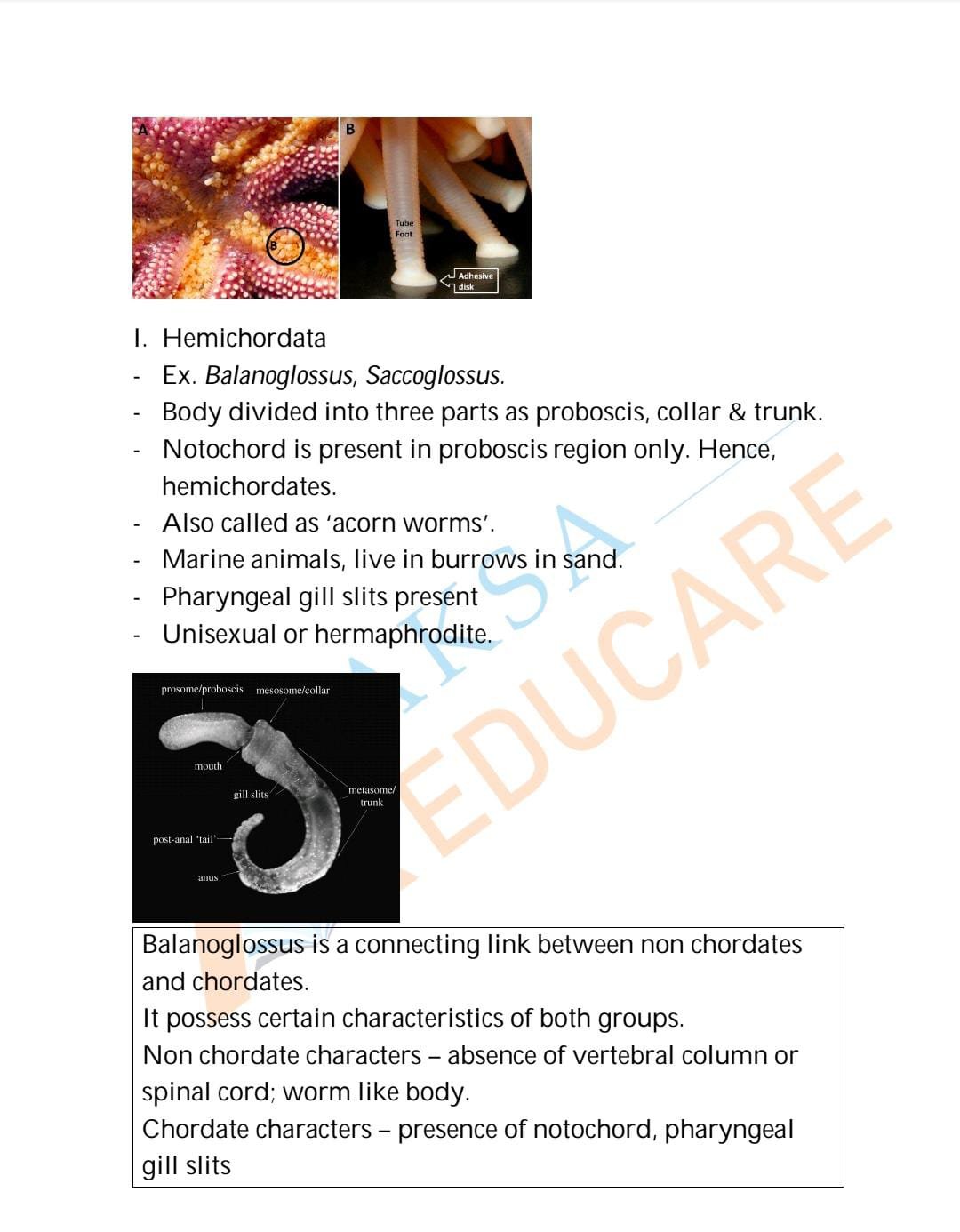
– Tube feet for locomotion and capturing prey.
– Skeleton of calcareous spines / ossicles
– Power of regeneration
– Unisexual.
animal classification
animal classification
PHYLUM CHORDATA –
It is divided into 3 sub phyla –
A. Sub phylum – Urochrodata
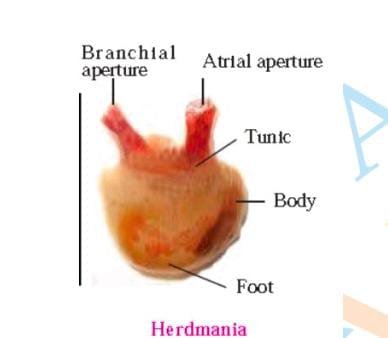
– Ex. Herdmania, Doliolum, Oikopleura, etc
– Marine
– Body is covered by skin-like test or tunic.
– Larvae are freely swimming
– Notochord is present in only tail region of larvae. Hence, they are called Urochordata.
– Larvae metamorphose into adults after settling down at bottom of the sea.
– Hermaphrodite
animal classification
B. Sub phylum -Cephalochordata Ex.: Amphioxus
– Small, fish-like, marine animals.
– Notochord is present throughout the body length.
– Pharynx is very large and contains gill-slits.
– Unisexual.
C. Sub phylum -Vertebrata/Craniata
– Notochord is replaced by vertebral column.
– Head is well developed.
– Brain protected by cranium.
– Endoskeleton is either cartilaginous or bony.
– Some chordates are jaw-less (Agnatha) whereas some are with jaws (Gnathostomata).
Subphylum- Vertebrata is divided into six classes –
a. Class- Cyclostomata
Examples: Petromyzon, Myxine, etc.
– Have jaw-less mouth provided with sucker.
– Skin is soft and without any scale.
– Paired appendages are absent.
– Endoskeleton is cartilaginous.
– Most of the animals are ectoparasites.
b. Class- Pisces
Examples.: Rohu, Pomfret
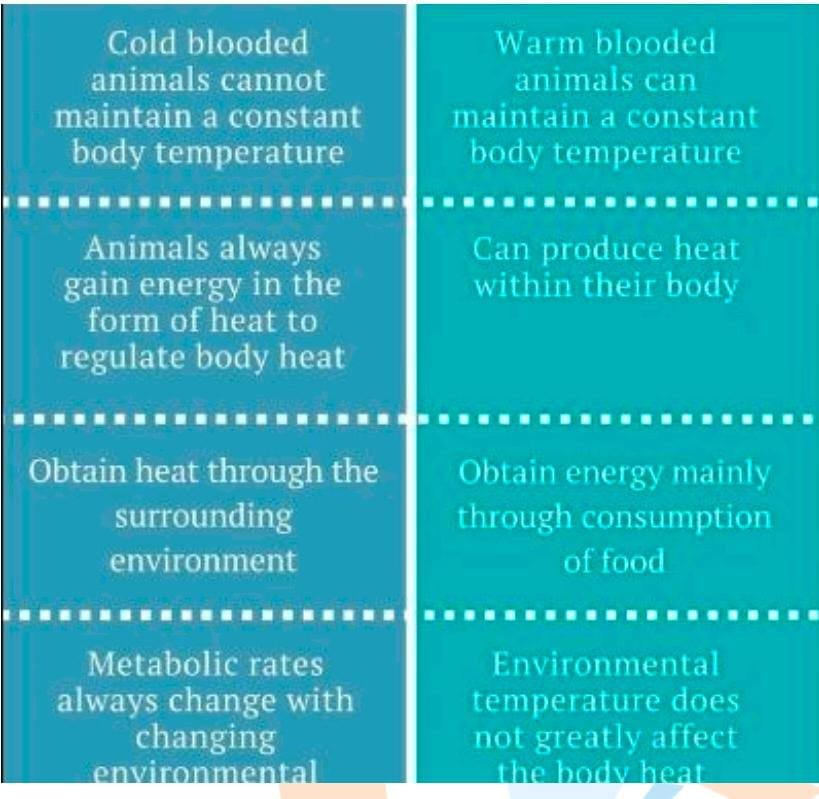
– Cold blooded (Poikilotherms) aquatic
– Body spindle shaped to minimize water-resistance.
– Have paired & un-paired fins for swimming. Tail fin useful as a steering organ during swimming.
– Exoskeleton – scaly & endoskeleton – cartilaginous or bony.
– Respiration – gills.
c. Class- Amphibia
Ex.: Frog, Toad, Salamander, etc.
– Strictly aquatic during larval life and perform only aquatic respiration.
– Live in water as well as on land during adult life
– Two pairs of appendages.
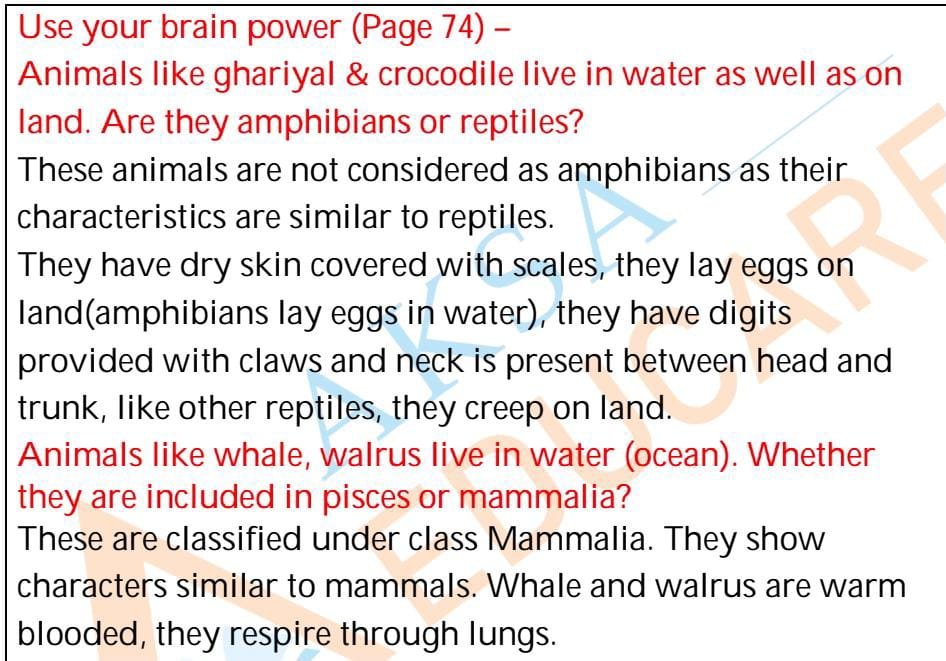
– Digits without claws.
– Exoskeleton absent. Skin is usually moist and used for respiration.
– External ear is absent but tympanum is present.
– Neck absent.
– Eyes are prominent with eye lids.
d. Class- Reptilia
Examples: Tortoise, Lizard, Snake, etc.
– First true terrestrial animals
– Cold blooded (poikilotherms)
– They creep on the land.
– Skin is dry and scaly.
– Neck is present between head & trunk.
– External ear is absent.
– Digits are provided with claws.
animal classification
e. Class- Aves
– Completely adapted for aerial life.
– Warm blooded (Homeotherms).
– Body is spindle-shaped to minimize air resistance during flight.
– Forelimbs modified into wings.
– Digits covered with scales and bear claws.
– Exoskeleton of feathers.
– Neck is present between head and trunk.
– Jaws are modified into beak.
f. Class- Mammalia
– Presence of mammary glands is typical character of Mammalia.
– Warm blooded.
– Body is divided into head, neck, trunk and tail.
– Digits are provided with nails, claws, or hooves.
– Exoskeleton in the form of hairs or fur
animal classification
https://akshatakirpekar.com/?p=25675&preview=true
https://youtu.be/zV0gwjYePlI?si=2jIp9Gnfv2nJ2PRD
animal classification